(708658) Turowicz
A rock estimated at half a kilometre to a kilometre across, orbiting the Sun between Mars and Jupiter. It is named after Jerzy Turowicz (1912–1999), long-time editor-in-chief of the Polish Catholic weekly Tygodnik Powszechny.
Computing position…
Sources and notes
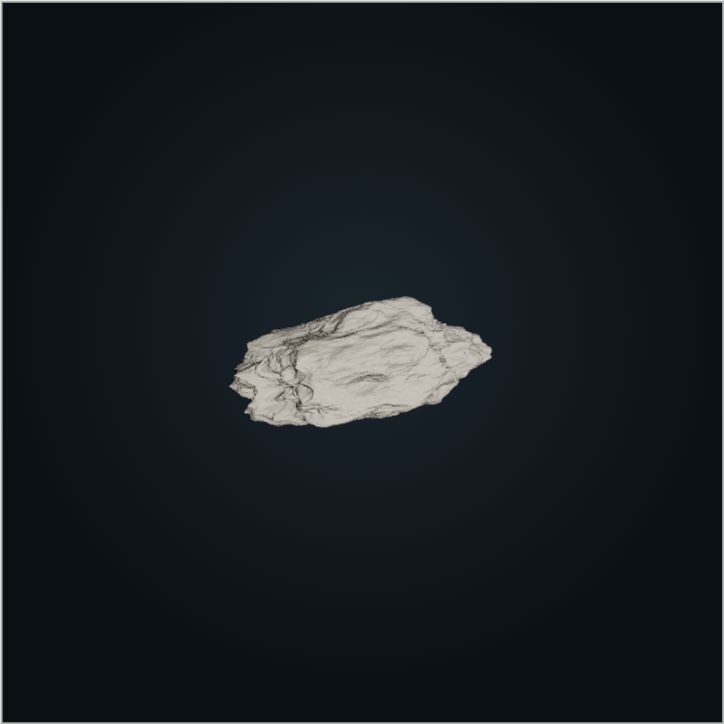
Shape and rotation are illustrative — Turowicz’s real shape is unknown. Light falls at the angle at which the asteroid is seen from Earth today (—).
Asteroids of this size can be round with an equatorial ridge (“spinning tops”), strongly elongated, or made of two joined lobes. For Turowicz there is no way yet to say which is more likely, so the model at the top is a moderately elongated body without features that have not been confirmed.
Where is it now
The Sun, the planets and the asteroid at a chosen moment. Distances are to scale; body sizes are enlarged. Drag the timeline or run the simulation forwards or backwards.
Sources and notes
The asteroid belt and background stars are illustrative. Positions: planets — astronomy-engine; asteroid — JPL Horizons ephemeris 1900–2100, a Keplerian approximation outside that window.
Visibility and distance from Earth
Earth orbits the Sun faster than Turowicz, so on average every 16.5 months or so it catches up and overtakes it. The asteroid is then at opposition: closest and best placed for observation — though even then it is only about magnitude 20–22, within reach of a camera on a large telescope. When the two are on opposite sides of the Sun, they are almost 3.8 au apart.
Equipment classes are rough and assume dark skies; height above the horizon is at culmination for latitude 52° N.Sources and notes
Sources and notes
Own computation from JPL Horizons ephemeris (1900–2100) and the astronomy-engine library; Keplerian approximation after 2100.
Upcoming oppositions
| Date | Distance from Earth | Magnitude V |
|---|
Data
Values from the NASA/JPL Small-Body Database, refreshed daily. Every row links to its source.
| Parameter | Value | Source |
|---|
Compared with known asteroids
Turowicz’s diameter has not been measured. Its absolute magnitude H = 18.57 implies about 0.43 km for a bright surface (albedo 0.35, typical of the Vesta family, to which the SsODNet catalogue assigns it) or about 1.05 km for a dark one (albedo 0.06). The “about 850 m” quoted in the media is an estimate with an undisclosed albedo. Next to it — asteroids with measured shapes, all to one scale. Click a name to see the shape up close.
Sources and notes
Shapes: Itokawa, Ryugu, Didymos — from spacecraft; Bennu, Moshup, Geographos — from radar (NASA PDS and JAXA DARTS archives), simplified to about 2,500 triangles. Dinkinesh and 1996 FG3 have no public shape model.
Sources and notes
To one scale: a sphere with Turowicz’s diameter in both scenarios over Kraków — the Main Square (about 4 ha) and the Wawel castle complex (about 5.6 ha, centres about 0.8 km apart). The second section is centred on the building at Wiślna 12; it also marks the buildings at Sobieskiego 7 (the namesake’s birthplace, plaque since 2012) and Lenartowicza 3 (his home in 1945–1999) where they fall within the section. Outlines of the squares, the castle and the buildings (found by address) follow OpenStreetMap. Base map: data © OpenStreetMap contributors (ODbL), stored on this site — your browser does not connect to OpenStreetMap.
Namesake
Jerzy Turowicz (10 December 1912 – 27 January 1999) was a Kraków journalist and writer, co-founder and editor-in-chief of the Catholic weekly Tygodnik Powszechny in 1945–1953 and 1956–1999. The gap covers the years after Stalin’s death, when the editors refused to call him “the greatest figure of the age” and the PAX Association took over the paper; the original team returned in the autumn of 1956.
He reported extensively on the Second Vatican Council (1962–1965). In 1964 he signed the “Letter of 34” in defence of cultural freedom, and in 1989 he was a member of the Citizens’ Committee around Lech Wałęsa and took part in the Round Table talks. He co-founded the Znak monthly and publishing house. In 1994 he received the Order of the White Eagle. He is buried in Tyniec.
The name was published in November 2025 by the International Astronomical Union’s Working Group for Small Bodies Nomenclature (WGSBN Bulletin 5, no. 25, p. 8). More about him (in Polish): the Jerzy Turowicz Foundation and the Wiślna 12 archive; about the naming: “Planetoida im. Turowicza”.
—
times the asteroid circled the Sun. One orbit takes about 3 years and 8 months.
Discovery
According to the official discovery credit, the asteroid was recorded on 3 September 2013 by two Polish amateur astronomers, Michał Żołnowski and Michał Kusiak, at the remotely operated Rantiga Observatory in Tincana, Italy (MPC code D03, 0.4 m telescope). The provisional designation 2012 GJ42 comes from earlier observations made in April 2012, and the oldest position used in its orbit dates from 28 September 2002. These are three different catalogue records, not a contradiction.
A permanent number is assigned only once the orbit is known well enough that the object cannot be “lost”. The discoverers may then propose a name. The same discoverers also found, among others, the asteroid (690092) Stuhr.
Turowicz’s orbit has an uncertainty code of 0 — the best on the Minor Planet Center’s ten-step scale. JPL bases it on 90 observations from 2002–2024.
The SsODNet catalogue assigns the object to the Vesta family — a group of asteroids on similar orbits (HCM method, Nesvorný et al. 2015). This does not prove it is a fragment of Vesta; Turowicz’s spectral type remains unknown.
How we computed it
- Orbit
- Orbital elements and brightness from the JPL Small-Body Database. For 1900–2100 the position comes from JPL Horizons tables (every 5 days, including planetary perturbations), interpolated between nodes. Outside that window we use a Keplerian ellipse, and the panel shows an “approximation” badge.
- Planets
- The astronomy-engine library (MIT licence), accurate to about one arcminute.
- Time
- Computations in TDB; from 1972 onwards UTC is converted using the IERS leap-second table.
- Size
- Nobody has measured the diameter. The formula D = 1329 km / √pV · 10−H/5 with H = 18.57 gives about 0.43 km for albedo 0.35 (the Vesta-family average) and about 1.05 km for albedo 0.06. The uncertainty of H alone (±0.39 mag) shifts each value by about −16% / +20%. These are scenarios, not a confidence interval.
- 3D model
- An artist’s impression. The DAMIT shape-model database, light-curve databases (LCDB, ALCDEF) and WISE/NEOWISE, AKARI and IRAS measurements contain no shape, rotation period, diameter or albedo for this asteroid (source search of 26 November 2026). Only a single colour measurement from the SDSS survey is known.
- Apparent magnitude
- The H, G system with G = 0.15; without the unknown variation caused by rotation.